

Sourdough Boule
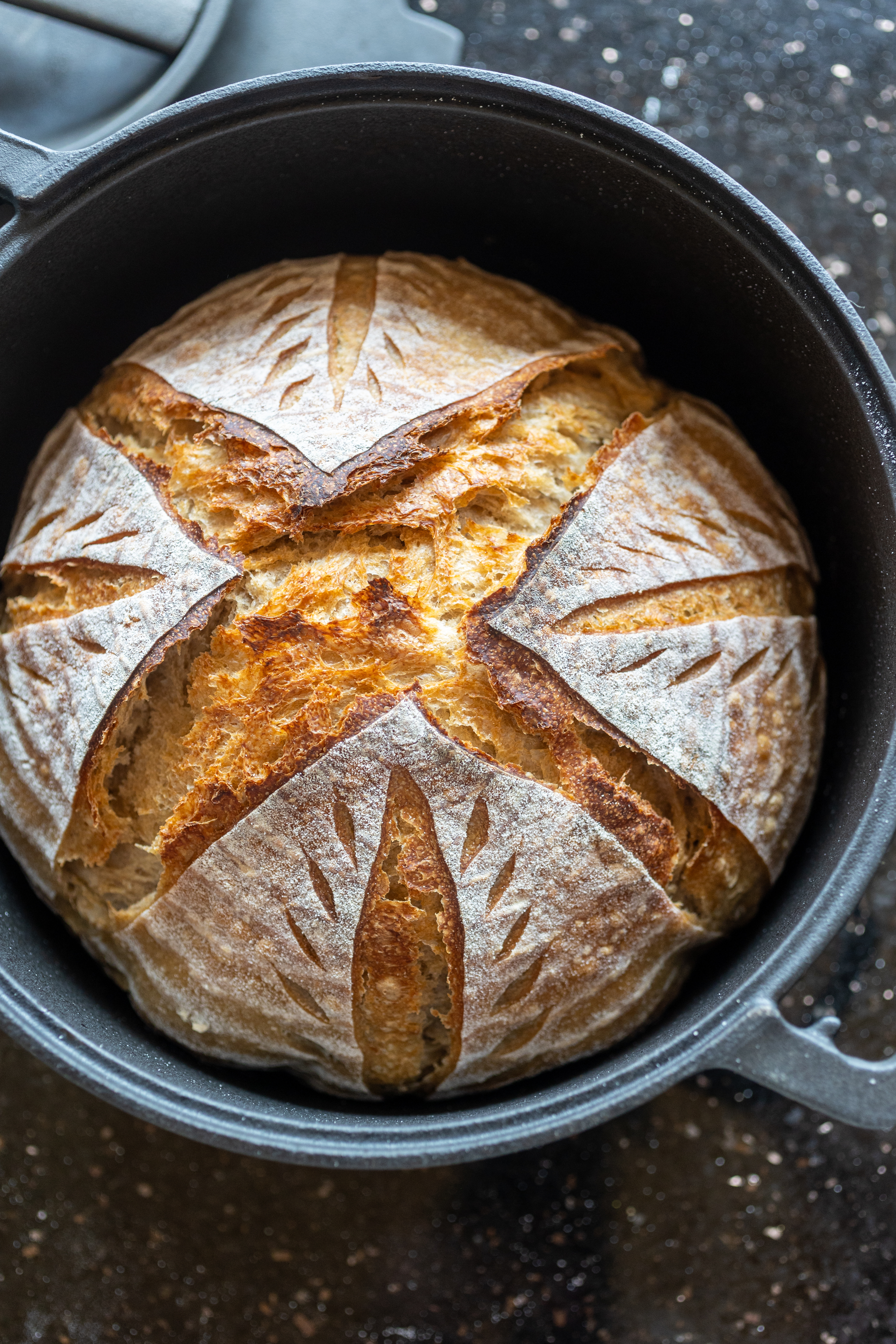
If you were to ask me 5 years ago if I would be sharing a recipe for a loaf of sourdough, I would have told you that you were out of your mind. However, that all changed a year or so ago when I was in Georgia visiting family. My cousin, Steph, would make at least one loaf regularly, and after staying there for a few days, I realized how easy it really was. Easy, yes, but time consuming. After some convincing, I found myself baking alongside her and realized that it wasn’t as bad as I had made it out to be in my head. Like everything else in life, you just have to plan for it. For her, it’s second nature. The dough was like another kid to her, and all she had to do was keep its schedule on track. And, unlike her actual kids, she didn’t have to worry about the bread talking back or complaining!
For the most part, everything I know about sourdough is thanks to her and my cousin Tracy who’s my supplier (of starter!). If you’re serious about giving it a go, be sure to read my full sourdough guide on SubStack by clicking HERE!

Sourdough Boule
Ingredients
- 100 grams active starter
- 350 grams warm water
- 500 grams bread flour
- 17 grams kosher salt
- All-purpose flour, for dusting
Instructions
- In a large glass bowl, using a Dutch whisk, mix the starter and warm water to combine.
- Add the bread flour and salt and mix until well combined. If you’re having trouble getting all the flour to incorporate with the whisk, you can use your hands to finish bringing the dough together, making sure all the flour has been incorporated. Do not worry about the dough looking rough and shaggy at this point.
- Cover with plastic wrap and let sit, allowing the flour to fully hydrate, for 1 hour.
- Working at the furthest “corner” of the bowl, grab the dough and gently tug to stretch it, then fold the dough over itself.
- Rotate the bowl, a quarter of a turn and repeat.
- Continue rotating the bowl a quarter of a turn, stretching and folding the dough over itself each time, until you’ve made a full rotation and have made 4 folds. Let rest for 30 minutes.
- Repeat this process two more times, allowing the dough to rest for 30 minutes between each set. After the final set of folds, allow the dough to rest and ferment at room temperature for 4 to 6 hours. With each set of stretch and folds, you should notice that the dough is getting stronger and it takes a bit more effort to stretch it. It should also get consistently smoother with each set.
- Sprinkle a clean work surface with a very light dusting of all-purpose flour. Dump the dough onto the surface. Grab the dough from one “corner” of the outer edge and pull it into itself, pinching it into the center, to create tension along the exterior. Moving in a clockwise motion, continue this action until you’ve made your way back to where you began.
- Carefully flip the dough over so that the pinched center is on the bottom.
- Using your hands, gently cup the bottom edge of the dough and rotate to create additional tension and finesse the shape into a circle.
- Flip the dough over, so that the smooth part is on the bottom, into a round proofing basket fitted with a cotton or rattan (a food grade webbed fabric) liner.
- Cover the basket with a clean linen kitchen towel and refrigerate overnight.
- Place a 5-quart or larger-sized Dutch oven and lid into the oven, set the oven to 450-degrees, then preheat for 30 minutes.
- Carefully flip the dough onto a silicon sling.
- Using a bread lame, score the bread by making a crescent-shaped slit, about ¼-inch deep, starting and ending at the center of the dough.
- Carefully remove the lid of the Dutch oven and lower the dough into the pot.
- Cover, return to the oven and bake for 30 minutes.
- Carefully remove the cover and continue baking until the crust is deep golden brown and the bread is cooked through, for 15 minutes more.
- Using the tabs on the silicone sling, carefully remove the boule from the Dutch oven and transfer to a cooling rack.
- Cool for at least 30 minutes before serving. Serve warm or at room temperature with some good salted butter.


I get an amazing boule every single time I use this recipe that I’ll never use another. Five ⭐️’s
So glad you love it!!!